The Georgian period, from 1714 to 1837, was named and defined by four Georges; George I (r. 1714-1727), George II (r. 1727-1760), George III (r. 1760-1820), and George IV (r. 1820-1830) along with William IV (r. 1830-1837). This period, which spanned most of the XVIII Century and a part of the XIX, was marked by significant changes when the entire globe was transformed.
It was a time of the decorative aesthetics of Rococo (late Baroque), Neoclassicism and Romanticism; the American and French Revolutions; George Washington, Napoleon Bonaparte and Catherine the Great. All of this combined with great achievements in science and world exploration, and changes in society created the perfect backdrop for the creation of the magnificent Georgian jewelry.
Prior to the mid-1700's attempts were made to setup by laws what items of clothing and jewelry could be worn based on rank or income. These sumptuary laws were often ignored and during the Georgian era they largely disappeared. Jewelry styles came to be designated as to the time of day they should be worn.
During the daylight hours women wore a necklace or chain with a watch, a cameo or lace pin, small colored stone rings, matching bracelets and earrings of any length. Gentlemen could not be seen anywhere without a fabulous pair of status establishing shoe buckles and buttons made from any material and studded with diamonds, paste and gemstones.
Garnet, topaz, emerald and ruby were popular, and materials from nature were abundant in daytime jewelry. Coral, amber, ivory, pearls along with turquoise, translucent agates and carnelian were used in a variety of ways. Strands of beads, riviere necklaces, parures, cameos and intaglios all featured these natural gems.
Right alongside, and almost equally as popular, were the imitations: paste, faux pearls, opaline glass, Vauxhall glass, etc. Iron and cut steel, pinchbeck (alloy of copper and zinc to substitute gold), silver and gold were all utilized as materials for Georgian jewelry; timeless long chains were a signature of that period.
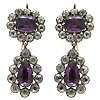
The evening was an entirely different story; diamonds were abundant at night, often in a way of the diamond riviere (river of light). They were also made with pastes and colored gemstones set in gold, silver and pinchbeck. Parures often included as many as sixteen items. Each item was created to compliment the other and ultimately highlight the lady's gown. A foil and closed back combination to mount gems is a signature element in Georgian jewelry; this process served to brighten diamonds and intensify colored stones.
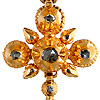
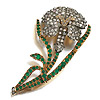
Necklaces evolved from ribbon style chokers early in the period to grand glittering cascades of gems. Cut steel jewelry became popular with graduated drops, flowers and garlands. Girandole earrings were by far the most loved style for evening wear. Later, pendeloque earrings became the preferred style. Brooches evolved from the demure gemstone bouquets to magnificent naturalistic ones. Bows, feathers, crowns, cornucopia, crosses, flowers, insects and birds were other frequent themes from the period.
Rings were often styled with a larger central stone surrounded by small diamonds. Often, the large center stone was a foiled "lesser" stone or made of paste. Bands, set all around or half way with gemstones, were worn singly or in stacks. Magnificent hairstyles required equally magnificent jeweled adornments.
Tiaras, coronets, bandeaus, diadems, aigrettes, combs and hairpins were expressed in diamonds and colored gems. Portrait miniatures, hair jewelry, silhouettes and eye miniatures comprised tokens of love and remembrance during the Georgian era. Jewelry made of hair came to a peak near the end of the Georgian era when complete sets of jewelry including bracelets and necklaces were woven entirely out of hair.
Jewelry did not go from "Georgian" to "Victorian" simply as a result of the coronation of a new monarch. Georgian elements and themes continued to be used during the reign of Queen Victoria and some were revived later in the period. Mourning jewelry, cameos, portrait miniatures and many other items remained a constant, with stylistic changes, through both periods.
Information used in this article is courtesy of The Antique Jewelry University