The Arts and Crafts movement (not style!) was an international movement in the decorative and fine arts that flourished in Europe and North America between 1880 and 1910, emerging in Japan in the 1920s. It stood for traditional craftsmanship using simple forms, and often used medieval, romantic or folk styles of decoration.
Essentially, it was anti-industrial and advocated economic and social reform. The guild revival movement breathed new life into the business of designing and making jewelry. Its influence was felt in Europe until it was displaced by Modernism in the 1930s, and continued to be popular among craft makers and designers long afterwards and even now.
The Arts and Crafts movement emerged and developed as a reaction to the Industrial Revolution against contemporary styles that the reformers associated with machine-production, partly a reaction against the style of many of the items shown in the Great Exhibition of 1851. Manufactured goods were artificial, often ornate but poorly designed, using inferior materials and produced by abused factory workers.
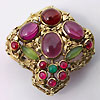
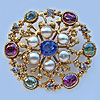
So, many artists including jewelry designers rebelled against that, returning to intricate designs and individual handmade craftsmanship as a way to provide art and beauty into every home. It was common for jewelry of this era to be simple in pattern and made of colorful, uncut stones and very often in cabochon cut.
Arguably, the other main aim of the Craft Revival was to bring the pleasure of original creative activity into the lives of the men and women of the working classes, and to relieve the monotony of the repetitive mechanical labor for the greater part of their working hours.
Advocates like William Morris, Owen Jones and John Ruskin were relentless in their push toward a medieval style to produce items used in everyday life. Gothic and Renaissance revival movements in jewelry turned to the past for pleasing shapes and motifs. A back to nature styling which relied heavily on floral and foliate motifs along with insects, shells and other objects from nature emerged like a breath of fresh air.
The Arts & Crafts movement heavily relied on a guild style education and employment of crafts-persons who could then execute patterns provided by their designers. Small workshops, art schools and independent designers were also a big part of the Arts & Crafts movement.
The Arts and Crafts Exhibition Society, along with the traditional international Exhibitions provided a forum for displaying and advertising the work of the many guilds and individual crafts persons because it was not economically feasible for each guild or workshop to have their own commercial venue.
A riot of enameled colors, glimmering cabochons and sinuous designs captured the imagination of ambitious artistic minded individuals. A return to the past (and to the Far East) for inspiration and technique pushed artisans and designers headlong into a future that would forever alter our sense of pleasing design and true beauty.
Soon after the exhibition of 1861, Japanese decorative objects became extremely desirable. Japanese design influence, as well as their innovative use of mixed metals, began to seep into jewelry design. This perfect storm of change, revival and discovery led not only to the Arts & Crafts Movement, but also to the overlapping Art Nouveau, Late Victorian, Edwardian and Belle Epoque aesthetics, not only coincidental in time but in various design elements, techniques and materials.
The theory of Arts & Crafts said that beauty of handmade items should rely only on their design and not the intrinsic value of their component parts for their esteem. Specialization by crafts-persons went against the principles, each piece was to be made by one person from beginning to end. All of these elements were aimed to keep cost affordable to the middle class.
The craftsmen even eschewed the use of precious stones and employed silver, aluminum and copper as the basis for their creations when gold was used it was usually only as a minor accent. A hammered texture was popular for its sheen and its departure from smooth, shiny, machine made counterparts. Baroque pearls, mother-of-pearl and freshwater pearls were used often, the popular stones were moonstone, turquoise, garnet, opal and amethyst.
Hand painted enamel as a decorative element was an important mechanism for separating the handmade from machine made. Very often employed distinguishing design element is the use of leaves, and the variation of leaves used by different artisans could even identify the maker. Medieval and Renaissance styling was the main motif with necklaces, pendants, clasps and buckles the most popular and useful items produced.
Employing a methodology whereby the craftsman executed all elements of a piece from design to creation proved to be costly and often yielded poor results, ironically, the items thus intended for the masses were only affordable by the elite. The experiment, which rejected all use of machinery, was failing. Some of the most successful firms actually used mechanized systems to produce jewelry designed by the most popular Arts & Crafts artisans resulting in a mass-market success.
The movement waned before World War II. Individual artisans continued to work in the Arts & Crafts style adapting their work to the changing tastes of the Modernist movement. Independent jewelers, working in a handmade style using techniques taught during height of the Arts & Crafts movement, have continued to produce popular jewelry without the support of guilds and societies dedicated to the idealistic revolt against machine made goods.
Information used in this article is courtesy of The Antique Jewelry University