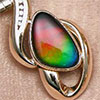
Ammolite is an opal-like organic
gemstone found primarily along the
eastern slopes of the Rocky Mountains
of North America. It is a thin
iridescent aragonite shell material
that is found on two species of
extinct ammonite fossils; the same
mineral contained in nacre. Ammolite
is one of few biogenic gemstones;
others include amber and pearl,
mother-of-pearl, coral, gagate (jet).
Ammolite is also known as
AAPOAK (the Kainai Nation
word for "small, crawling stone"),
"ammonite shell", "gem ammonite",
"calcentine", and "korite". The
latter is a trade name given to the
gemstone by the Alberta-based Canada
mining company Korite International,
the first and largest commercial
producer of ammolite.
Significant deposits of gem-quality
ammolite are only found in the
Bearpaw Formation that extends from
Alberta to Saskatchewan in Canada
and south to Montana in the USA.
However, small deposits have been
found as far south as Central Utah
which also contains gem-quality
ammolite. The best grade of gem
quality ammolite is along high
energy river systems on the eastern
slopes of the Rockies in southern
Alberta.
The grade and therefore the value
of an ammolite gemstone is
determined by the following criteria:
the number of primary colors (red
and green are far more common than
blue or purple), the way the colors
"play" (how the colors vary with the
angle of viewing and the angle of
light striking the gemstone),
brightness of colors (iridescence).
The thickness of the ammolite layer
is also an important factor: after
polishing, the ammolite is only
0.1-0.3 millimeters thick. Ammolite
is usually fashioned into freeform
cabochons and mounted in gold, with
diamonds as accents. Due to its
delicacy, ammolite is best reserved
for use in pendants, earrings, and
brooches.