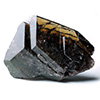
Axinite is a rare group of silicate
minerals that usually occur in long,
flat, axe- or spatula-shaped crystals.
The name "axinite" was derived in
1787 from a Greek word meaning "axe".
All members of axinite mineral group
share the same crystal system, and
have slightly different compositions.
Axinite color varies from lilac
to violet and from brown to reddish
brown depending on its composition,
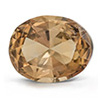
but most axinite gemstones occur with
a golden brown color.
Axinite is one of the few gemstones
that possess a unique feature known
as pleochroism (capability to display
a variety of colors depending on the
light and angle from which they are
viewed). When a polished crystal of
axinite is rotated, different colors
are displayed. Axinite is a very
popular gemstone among mineral
collectors due to its rarity and
unusual crystal structure and crystal
shapes, and pleochroism.
Axinite gemstones develop and form
within cavities and veins of granite.
Some of the finest Axinite crystals
have come from France, Switzerland,
England, Brazil, Mexico, USA, Sri
Lanka, Pakistan and Tanzania, Japan,
Australia, Canada. Russia has
produced exceptionally well-formed,
large transparent crystals in the
Urals. Also in Russia is the famed
locality of Dalnegorsk, Primorskiy
Kray, which has produced distinct,
pointy aggregates of axinite.
Axinite almost always has inclusions
and eye-clean specimens are very
rare. Axinite has a vitreous luster
when cut and polished. Axinite is
typically faceted and not cut en
cabochon, unlike smoky quartz, which
can closely resemble axinite.
Traditional cuts like oval, round,
pear and cushion are most popular,
but since axinite is relatively
rare and unheard of, fancy shapes
such as trillions and hearts are
hard to find due to limited demand.