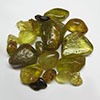
Chrysoberyl is a hard, tough, and durable
gem. The name chrysoberyl is derived from
the Greek words CHRYSOS and
BERYLLOS, meaning "a gold-white
spar". Despite the similarity of their
names, chrysoberyl and beryl are two
completely different gemstones, although
they both contain beryllium. An
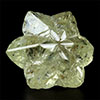
interesting feature of its crystals is
the cyclic twins called trillings. These
twinned crystals have a hexagonal
appearance as seen on the second picture.
Although lacking the fire of other
gemstones, chrysoberyl in its various
forms can be quite valuable.
Most chrysoberyl gems are yellow, though
some are brown, green, or orange, and
transparent to translucent. When the
mineral exhibits good pale green to
yellow color and is transparent, then
it is used as a gemstone. The three main
varieties of chrysoberyl are: ordinary
yellow-to-green chrysoberyl,
cat's eye or cymophane, and
alexandrite. Yellow-green chrysoberyl
has been referred to as "chrysolite"
during the Victorian and Edwardian eras,
which caused confusion since that name
has also been used for the mineral
olivine ("peridot" as a gemstone); that
name is no longer in use.
Alexandrite is a strongly pleochroic
gem exhibiting emerald green, red and
orange-yellow colors depending on
viewing direction in partially
polarized light. However, its most
distinctive property is that it also
changes color in artificial light
compared to daylight. Cymophane is
popularly known as "cat's eye". This
variety exhibits pleasing chatoyancy
or opalescence that reminds one of
the eyes of a cat. When cut to produce
a cabochon, the mineral forms a
light-green specimen with a silky band
of light extending across the surface
of the stone.
All colors of transparent chrysoberyl
can be faceted into gemstones. Despite
its appealing and valuable nature,
chrysoberyl is not extensively used
in jewelry. The most common colors for
chrysoberyl jewelry are yellow,
greenish-yellow, and brownish-yellow.
"Cat's eye" is polished into cabochons,
and usually has a yellow-brown,
greenish-brown, greenish-gray, or
gray color. Alexandrite is used as
rare and exquisite jewelry piece, and
most often faceted into round and
cushion cuts that are used in rings
and pendants.