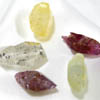
Corundum is a rock-forming mineral. It is one of
the naturally transparent materials, but can have
different colors when impurities are present.
Transparent specimens are used as gems, called
ruby if red and padparadscha (sapphire) if
pink-orange. All other colors are called sapphire,
e.g., "green sapphire" for a green specimen. The
name "corundum" is derived from the Tamil word
KURUVINDAM or Sanskrit word KURUVINDA
meaning ruby.
Because of corundum's hardness, it can scratch
almost every other mineral. It is commonly used
as an abrasive on everything. Corundum for
abrasives is mined in Zimbabwe, Russia, Sri
Lanka and India. Historically it was mined from
deposits in North Carolina, USA and in Craigmont,
Ontario, Canada. Four corundum axes dating back
to 2500 BCE from the Liangzhou culture have been
discovered in China. The surfaces of the axes
are remarkably smoothly polished.
In 1837, Marc Antoine Gaudin made the first
synthetic rubies. The Verneuil process
developed in 1902 by the French chemist Auguste
Verneuil, also called flame fusion, allows the
production of flawless single-crystal sapphires,
rubies and other corundum gems of much larger
size than normally found in nature.
Because of the simplicity of the methods
involved in corundum synthesis, large quantities
of these crystals have become available on the
market causing a significant reduction of price
in recent years. Apart from ornamental uses,
synthetic corundum is also used to produce
mechanical parts (tubes, rods, bearings, and
other machined parts), scratch-resistant optics,
scratch-resistant watch crystals, instruments,
windows for satellites and spacecraft (because
of its transparency in the ultraviolet to
infrared range), and laser components.