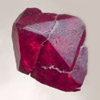
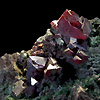
Cuprite is a red to brown mineral with high
copper content. Its crystals are transparent
to translucent; the color is dark red to
cochineal red, brown red, purple red,
sometimes almost black. Cuprite is often
associated with native copper, malachite,
azurite, limonite and chalcocite.
Cuprite is named in 1845 by Wilhelm Karl von
Haidinger from the Latin CUPRUM -
copper, in allusion to its composition.
Haidinger renamed a previously known mineral
that had been known by a wide variety of
names.
Cuprite has been a major ore of copper and
is still mined in many places around the
world. Some of the most outstanding lustrous
dark red octahedral Cuprite crystals and
groupings come from Kolwezi, Katanga (Shaba),
Democratic Republic of Congo. Exceptionally
large crystals, often coated with a shiny
green coating of Malachite, are well-known
from Ogonja, Namibia; the classic locality
for fine Cuprite is Tsumeb, Namibia. Other
notable occurrences of cuprite include
Ural and Altai Mountains, Russia; Arizona,
USA; Dzezkazgan, Kazakhstan; Queensland,
Australia; Cornwall, England; France, China,
Chile and other localities.
Cuprite can form both as bright transparent
red crystals, and as lustrous, submetallic
to brilliant opaque crystals. Even the opaque
form will have slightly red edges and slight
transparency upon back-lighting. The
"chalcotrichite" (from the Greek, meaning
"hairy copper") variety typically shows
greatly elongated capillary or needle like
crystals forms.
Though almost all crystals of cuprite are far
too small to yield faceted gemstones, one
unique deposit from Onganja, South West
Africa, which was discovered in the 1970s,
has produced crystals which were both large
and gem quality. According to Joel Arem,
one-time curator for the Smithsonian National
Gem and Mineral Collection in Washington
DC, faceted cuprite of any size is considered
one of the most collectible and spectacular
gems in existence, with its deep garnet
coloring and higher brilliance than a
diamond. Only the gem soft nature prevents
it from being among the most valuable
jewelry stones.