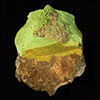
Gaspeite is a rare green mineral. It was
named after the Gaspe Peninsula of Quebec,
Canada, the location of where it was first
discovered and described in 1977. The
discovery of gaspeite is credited to
renowned American mineralogists, D.W.
Kohls and J.L. Rodda. Initially, it was
discarded as a worthless byproduct of
nickel sulfide mining.
Gaspeite is considered to be one of the
newer gemstones on the market, it has
recently become very popular among gem
and mineral collectors, mostly credited
to its rarity and its slight similarity
in appearance to rare green turquoise.
Gaspeite is typically pale green to
yellowish-green to bright apple-green
in color, often accompanied by brownish
veins of rock that run through the
material at various depths. Gaspeite
crystals are typically translucent, but
when found in its natural state, gaspeite
is opaque.
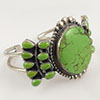
Gaspeite is typically shaped and polished
attractive apple-green color (often
veined) cabochons and beads for jewelry
use. On rare occasions, it may be faceted
for collectors or for display purposes.
The most common shapes are plain-cut
ovals, rounds and cushions. Fancy shapes
are quite rare, as are calibrated sizes.
Gaspeite is often carved into ornamental
objects and animal figurines and traded
in rough crystal form. Specimens may also
be polished or sliced into slabs when
sold on the market.
Gaspeite is an extremely rare mineral,
which belongs to the calcite group of
minerals, and is known to occur in a
small number of locations around the
world. Aside from its type locality in
Canada, some of the more significant
deposits are found in in New Mexico,
USA, also in Australia, Greece, Italy,
Spain, South Africa, Tanzania, Zimbabwe,
Germany, and Kazakhstan. Most gem-quality
specimens available today are sourced
from Western Australia or New Mexico,
USA.