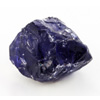
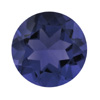
Iolite is a transparent gemstone variety of
the mineral cordierite. Iolite varies in
color from sapphire blue to blue violet to
yellowish gray to light blue as the light
angle changes. A cube cut from iolite will
look a more or less violet blue, almost like
sapphire, from one side, clear as water from
the other, and a honey yellow from on top.
The name "iolite" comes from the Greek
ION, which means violet.
The legends say that when Leif Eriksson and
the other legendary Viking explorers ventured
far out into the Atlantic Ocean, away from any
coastline that could help them determine their
position, they had a secret gem weapon: iolite.
The Viking mariners used thin pieces of it as
the world's first polarizing filter. Looking
through an iolite lens, they were able to
determine the exact position of the sun, and
navigate their way safely to the New World and
back.
The property that made iolite so valuable to
the Vikings is its extreme pleochroism and the
old name for iolite is "dichroite", a Greek
word meaning "two-colored rock". It has also
been called "Water Sapphire" and "Vikings'
Compass". Iolite is surprisingly affordable,
the richer the blue, the better. Iolite is
sometimes used as an inexpensive substitute
for sapphire but it is much softer and should
be protected from blows.
Nevertheless, iolite is relatively hard and
with its attractive color and reasonable
price is used in all types of jewelry. Iolite
is cut into gemstone facets and cabochons and
used to make rings, earrings, and pendants.
The Vikings probably mined their gems from
deposits in Norway and Greenland. Iolite is
also found in India, Sri Lanka, Burma,
Mozambique, Zimbabwe, Madagascar, Namibia,
Tanzania, Australia, Brazil, Canada, and the
United States. The largest iolite crystal
found weighed more than 24,000 carats, and
was discovered in Wyoming, USA.