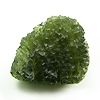
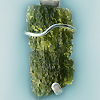
Moldavite (Czech: Vltavin from the Vltava river) is
an olive-green or dull greenish vitreous substance
possibly formed by a meteorite impact. It was
introduced to the scientific public in 1786 as
"chrysolites" from Tyn nad Vltavou in a lecture by
professor Josef Mayer of Prague University. The
term "moldavite" derived from the town of
Moldauthein (Czech: Tyn nad Vltavou) where the
described pieces came from was first used in 1836.
In 1900, F. E. Suess pointed out that the gravel-size
moldavites exhibited curious pittings and wrinkles
on the surface, which could not be due to the
action of water, but resembled the characteristic
markings on many meteorites. Boldly attributing
the material to a cosmic origin, he regarded
moldavites as a special type of meteorite. However,
for a long time, it was generally believed to be a
variety of obsidian. Currently scientists believe
that moldavites were formed about 14,700,000
years ago during the impact of a giant meteorite
in present-day Nordlinger Ries.
99% of all moldavite finds have come from the
South Bohemian localities, 1% were found in
South Moravian localities. Only tens of pieces
were found in the Lusatian area (near
Dresden), Cheb basin area (West Bohemia)
and Northern Austria (near Radessen). The
total amount of Moldavite scattered around
the world is estimated at 275 tons.
There are typically two grades of moldavite:
high quality, often referred to as museum
grade, and regular grade. The regular grade
pieces are usually darker and more saturated
in their green color, and the surface is seen
as closely spaced pitting or weathering. The
museum grade has a distinct fern-like pattern
and is much more translucent than the regular
grade. High-quality moldavite stones are often
used in hand-crafted jewelry and have gained
an almost cult status.