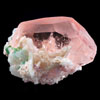
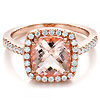
Morganite, also known as "pink beryl", "rose
beryl", "pink emerald", and "cesian (or caesian)
beryl", is a rare light pink to rose gem-quality
variety of beryl. Orange/yellow varieties of
morganite can also be found, and color banding
is common. It can be routinely heat treated to
remove patches of yellow and is occasionally
treated by irradiation to improve its color.
Pink beryl of fine color and good sizes was
first discovered on an island on the coast of
Madagascar in 1910. Some people say that the
first occurrence of morganite to be described
was a pale rose colored specimen from California,
where it was known with other gemstone minerals,
such as tourmaline and kunzite. In December 1910,
the New York Academy of Sciences named the pink
variety of beryl "morganite" after financier
J. P. Morgan.
The ancient Greeks used the refracting
property of beryl to make the first spectacles.
At the time of Nero, white beryl (or goshenite)
was found on the Island of Elba, and it was
then cut to be used to make the first eyeglasses.
Although pink, morganite is tied to the see,
just like aquamarine. It is often worn on water
as protection from the storms and the seas. The
interesting part of this legend is that in
ancient times it was also used to call the rain
during droughts.
Some of the finest morganite is from Madagascar,
as Brazil produces the pure pink crystals, as
well as some containing aquamarine in the same
crystal. On October 7, 1989, one of the largest
gem morganite specimens ever uncovered,
eventually called "The Rose of Maine," was found
at the Bennett Quarry in Buckfield, Maine, USA.
The crystal, originally somewhat orange in hue,
was 23 cm (9 inches) long and about 30 cm (12
inches) across, and weighed (along with its
matrix) just over 50 pounds (23 kg).