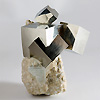
Today we'll talk about gold, more precisely,
about Fool's Gold. The mineral pyrite, or iron
pyrite, is an iron sulfide. This mineral's
metallic luster and pale brass-yellow hue have
earned it the nickname "fool's gold" because of
its superficial resemblance to gold. The color
has also led to the nicknames "brass", "brazzle"
and "Brazil", primarily used to refer to pyrite
found in coal.
The name pyrite is derived from the Greek
PURITES that means "of fire" or "in fire".
In ancient Roman times, this name was applied to
several types of stone that would create sparks
when struck against steel; Pliny the Elder
described one of them as being brassy, almost
certainly a reference to what we now call pyrite.
By Georgius Agricola's time, the term had become
a generic term for all of the sulfide minerals.
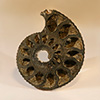
Pyrite is usually found associated with other
sulfides as well as in coal beds, and as a
replacement mineral in fossils. Despite being
nicknamed fool's gold, pyrite is sometimes found
in association with small quantities of gold.
It is distinguishable from native gold by its
hardness, brittleness and crystal form. Natural
gold tends to be irregularly shaped, whereas
pyrite comes as either cubes or multifaceted
crystals. Pyrite is mined in Norway, Spain,
Italy, Canada, USA, Japan, Russia; it is not a
separate subject of development and is produced
from sulfide ores during enrichment of the
related more valuable minerals.
Pyrite is used to make marcasite jewelry
(though marcasite is another mineral, sometimes
called white iron pyrite). In the late medieval
and early modern eras the word "marcasite" meant
both pyrite and marcasite (and iron sulfides in
general). Modern scientific definition for
marcasite dates from 1845, it is not used as a
gem due to its brittleness. Marcasite jewelry,
made from small faceted pieces of pyrite, often
set in silver, was popular in the Victorian era.
Carved pyrite and pyrite beads are also used in
jewelry today.