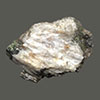
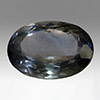
Sillimanite is a rare, transparent to
opaque gemstone that occurs in colorless,
grayish-white, yellow-green, bluish and
brownish hues. The luster of sillimanite
is vitreous to silky. Sillimanite belongs
to the same group of minerals as andalusite
and kyanite: they share a similar chemical
composition, but have differing crystal
structures. Sillimanite is the rarest of
them.
Sillimanite is named after the American
chemist Benjamin Silliman (1779-1864), the
founder of the American Journal of Science.
It was first described in 1824 for an
occurrence in Chester, Middlesex County,
Connecticut, USA. Sillimanite is usually
formed at high temperatures and is known
to be a useful heat-resistant and chemical
corrosion resistant material that is used
in iron and steel smelting, and the cement,
ceramics and glass industries.
The hardness of sillimanite along with its
resistance to heat means that it has good
durability. However, due to its rarity,
sillimanite is not often seen in jewelry.
Sometimes, faceted sillimanite is dyed to
imitate precious gemstones such as rubies
and emeralds. Sillimanite gems may appear
similar to a variety of other stones, such
as beryl and moonstone. Like diamond and
topaz, sillimanite has perfect cleavage,
which means that care should be taken when
setting and wearing sillimanite, since a
hard blow could cause it to split.
A common variety of sillimanite is known
as FIBROLITE, so named because the
mineral appears like a bunch of fibres
twisted together when viewed in thin
section or even by the naked eye. When the
fibers of sillimanite are chatoyant and
aligned in a certain way, they exhibit a
strong and sharp cat's eye effect, which
makes it valuable among collectors cut as
cabochons rather than faceted gemstones.
Some sillimanite gems possess strong
pleochroism, which means that three colors
may be exhibited in one gemstone depending
on the viewing angle. The secondary colors
typically seen in faceted sillimanite
specimens are yellow, green and blue.
Transparent sillimanite gems are often cut
into ovals to preserve the most carat
weight.
There are various sources of sillimanite,
including India, Burma, Kenya, Sri Lanka,
Europe and the USA. However, gem quality
sillimanite, especially transparent material
is rare. Sillimanite has also been found in
New Castle County, Delaware, USA, and in
1977 was named as the state mineral of
Delaware, though it was first identified in
Connecticut. There are sillimanite findings
in other areas, such as South Carolina and
Wyoming. Some sillimanite gems from the
Mogok region of Burma and the gem gravel of
Sri Lanka can appear similar to light blue
to colorless sapphire.