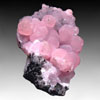
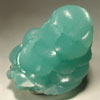
Smithsonite is a mineral ore of zinc,
it belongs to the calcite group of
minerals. Smithsonite is translucent
in clarity, with glassy or pearly
luster, it mostly occurs as blue
(sometimes mistakenly is called
"azurite"), green (apple-green to
dark variety is called "herrerite")
and pink stones. Beside these colors
smithsonite is also found yellow,
yellow-green, orange-yellow, purple,
gray, brown, white, and colorless or
faintly tinted in transmitted light.
The original name for the mineral of
smithsonite was "calamine" but James
Smithson (1754-1829), British chemist,
mineralogist, and benefactor of the
Smithsonian Institution (Washington,
DC, USA) distinguished that "calamine"
was in fact three different minerals:
hemimorphite, hydrozincite, and the
zinc carbonate. So, the actual
smithsonite was given that name in
1832 by Francois Sulpice Beudant in
honor of James Smithson.
The other name for smithsonite are
"Aztec Stone" (which is also a name
for the green variety of turquoise),
"Bonamite" (blue to green smithsonite
and also a name for smithsonite in
the gem trade), "Turkey-Fat Ore" -
which is the old name for the bright
yellow variety, and "Dry Bone Ore" -
that describes the massive, porous,
and dull variety.
Smithsonite is relatively soft for
jewelry, though it's sometimes
polished and used as an ornamental
stone. Smithsonite rarely occurs in
visible crystals. The only two
locations to produce large crystals
of significance are Tsumeb, Namibia,
and Broken Hill, Zambia. Many of
the rounded forms have a feathery or
sparkling light effect.
Large crusts are found in Italy,
Greece, Spain, Kazakhstan, Germany,
Poland, Russia. Mexico has two
outstanding localities which contain
beautifully colored smithsonite,
including deep pink and electric
green colors. The US has many fine
occurrences in the states of New
Mexico, Arizona, Arkansas, Colorado,
California, Utah and Wisconsin.