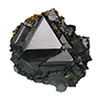
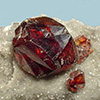
Sphalerite is a mineral that consists
largely of zinc sulfide in crystalline
form but almost always contains variable
iron. Sphalerite is the most commonly
encountered zinc mineral and the world's
most important ore of zinc. Its color is
usually yellow, brown, or gray to
gray-black, and it may be shiny or dull.
When pure (with little or no iron) it
forms clear crystals with colors ranging
from pale yellow (known as "cleiophane")
to orange and red shades (known as "ruby
blende" or "ruby sphalerite"), but as
iron content increases it forms dark,
opaque metallic crystals (known as
"marmatite").
Originally called "blende" in 1546 by
Georgius Agricola (Georg Bauer), in 1847
the mineral was named "sphalerite" by
Ernst Friedrich Glocker from the Greek
word SPHALEROS which means
deceiving or treacherous. This name
is in response to the many different
appearances of sphalerite and because it
can be challenging to identify in hand
specimens. Names for sphalerite used in
the past or by miners include "zinc
blende," "blackjack," "steel jack," and
"rosin jack."
Sphalerite is the major ore of zinc and is
found in thousands of locations worldwide.
The top producers include Russia, Ireland,
Spain, Germany, Switzerland, Czech Republic,
Romania, Bulgaria, England, Sweden,
Australia, Kazakhstan, China, India, Peru,
Bolivia, Mexico, Canada, and the United
States. In the United States, sphalerite
is produced in Alaska, Idaho, Missouri,
Kansas, and Tennessee.
Sphalerite is a difficult stone to cut and
polish. It is soft and it has cleavage.
Although sphalerite is not good for most
jewelry use, specimens of suitable size
with excellent clarity are sometimes cut
into gemstones usually featuring the
brilliant cut to best display sphalerite's
high dispersion which is over three times
that of diamond (dispersion is the ability
of a material to separate white light into
the colors of the spectrum as it passes
through the material). Owing to their
softness and fragility the gems are often
left unset as collectors' or museum pieces.
Gem-quality material is usually a yellowish
to honey brown, red to orange, or green.