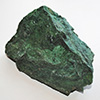
Verdite is the trade name for a light to
dark-green, yellowish-green, bluish-green
or brownish ornamental stone composed of
fuchsite and clayey material dating back
3500 million years ago. Since verdite is
a rock rather than a mineral, it doesn't
have a definite chemical composition.
Verdite is also known as Budstone or
African Jade. It often has spots or a
swirled appearance, a vitreous, silky or
pearly luster and is translucent to opaque.
Verdite was discovered in North Kaap
River, South Africa in areas where gold
was found; it is a rare, exotic and
wonderful stone of rare quality. The most
significant verdite deposits are found
in Zimbabwe. Though verdite is also found
in the Transvaal region of South Africa,
there is no other deposit of comparable
quality anywhere in the world than in
Zimbabwe.
Verdite has been used by South African
native ancient tribesmen for hundreds of
years as an ornamental stone and for
amulets and was also crafted into jewelry.
Verdite is often cut into cabochons, beads
and spheres. It is also tumbled and often
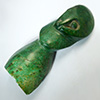
used for inlay. Verdite is frequently
carved into animal or human forms as works
of African art. The stone is rarely
faceted and not usually treated or enhanced
in any way.
In the knowledge that verdite is found only
in Southern Africa and noting in particular
that only Zimbabwe verdite has a uniquely
high quality it is being sought after by
international art collectors and investors
who have quickly recognized it as a rare
and intrinsically worthy material. That is
the reason why verdite art works have the
double attraction of beauty and a special
value. Because it is a quickly diminishing
resource the passage of time can only
enhance this attraction.