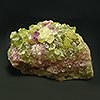
Vesuvianite, also known as idocrase,
is a green, brown, yellow, or blue
silicate mineral. It was first
identified and named by the famous
German gemologist Abraham Gottlob
Werner in 1795 after Mount Vesuvius
(hence its name) where fine brown
in color crystals of the mineral
were found in the ejected limestone
blocks. Several other names have
been applied to this species, one
of which, "idocrase" was given by
R. J. Haiiy in 1796. The name
"idocrase" comes from Greek words
meaning "mixed form", in reference
to the crystals showing a mixture
of other mineral forms.
Idocrase is an older synonym
sometimes used for gemstone-quality
vesuvianite. Italy contains numerous
localities that have produced
exceptional vesuvianite. A sky bluish
variety known as cyprine has been
reported from Norway and New Jersey,
USA; the blue is due to impurities
of copper. Californite is a name
sometimes used for jade-like
vesuvianite, also known as California
jade, American jade or vesuvianite
jade. Xanthite is a manganese rich
variety.
Wiluite is an optically positive
variety from the Wilui (Vilyui)
River Basin, Yakutia, Russia, it was
discovered in the 1990s. Wiluite was
previously regarded as a variety of
vesuvianite, but is now considered a
distinct mineral species. Other
sources of vesuvianite include China,
Switzerland, Pakistan, and Mexico.
Although many species of vesuvianite
are dull and uninteresting, there
are some highly lustrous and
brilliantly-colored forms of this
mineral that are outstanding
especially the multicolored varieties
that came from the Quebec, Canada.
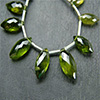
Attractive-looking crystals are
sometimes cut as gemstones, but
transparent specimens that can be
faceted are extremely rare. Most
gem-quality vesuvianite is opaque
with an appearance similar to jade.
The opaque specimens have a greasy
or resinous luster, while the rare
transparent form has a vitreous
luster. Recent finds in Kenya and
Tanzania have brought some very
fine stones to the market, albeit
in limited quantity. One source
of cabochon grade material is
California, USA.